REVIEW · CHIANG MAI
Half Day Traditional Handicraft Craftsmanship Tour from Chiang Mai
Book on Viator →Operated by Sightseeingbangkok.com · Bookable on Viator
A craft road tour in four hours is rare. This one gives you a guided hit of Chiang Mai handicrafts without the hard sell, plus door-to-door pickup and a small group that stays focused. I like watching artisans work up close, and I like that the stops are spread out enough to feel like a real day’s worth of making things, not a quick showroom run. The one drawback: the schedule is tight, so if you want long browsing time in shops, you’ll need to plan for that at the end.
In my experience with this kind of format, the best part is the pacing. A small group of up to 10 means your guide can answer questions about silk and woodwork while you’re still at the workbench. You’ll also move by air-conditioned vehicle between districts, which matters when Chiang Mai is hot and humid. Just wear comfortable shoes and expect some walking around markets and village streets.
In This Review
- Key things that make this Chiang Mai craft tour click
- San Kamphaeng and Bo Sang: why this combo works for first-timers
- Price and logistics: what your $65 includes in real life
- The 10-person group advantage on a craft highway day
- Stop 1 in Chiang Mai: arriving near San Kamphaeng
- The San Kamphaeng Saturday walking street market: silk weaving you can watch up close
- Baan Jang Nak: elephant wood carvings plus a makers’ workshop feel
- Bo Sang Umbrella Village: Saa-paper parasols made from scratch
- How good is this at $65: a value check for your morning
- Who should book this tour (and who might skip it)
- Tips to make the silk and umbrellas feel meaningful
- Should you book? My practical verdict
- FAQ
- How long is the Half Day Traditional Handicraft Craftsmanship Tour?
- What time does the tour start in Chiang Mai?
- Is hotel pickup included?
- Where does the tour go during the half day?
- Are admission tickets included?
- What is the group size limit?
- Do I need a child ticket or accompaniment?
Key things that make this Chiang Mai craft tour click

- San Kamphaeng Road focus: you’re on Thailand’s handicraft highway, not stuck in one shop zone
- Hand weaving demos: you get to see silk production methods explained while locals demonstrate by hand
- Baan Jang Nak museum-style stop: elephant wood carving processes plus an exhibit of native costumes and keepsakes
- Bo Sang umbrella making from scratch: Saa-paper parasols, explained in the village where they’re made
- Small group (max 10): more time for questions, less time waiting around
San Kamphaeng and Bo Sang: why this combo works for first-timers
Chiang Mai’s craft scene is easier to understand when you see it in the right order. San Kamphaeng Road sets the stage. It’s the area many visitors use to start connecting the dots between raw materials, factories, and finished products. Then Bo Sang (Umbrella Village) turns those materials into something very visual and easy to appreciate.
This tour is also built for people who want the making part, not just the shopping part. The schedule is centered on workshops, carving and production processes, and short guided explanations. You still have time to purchase mementos at the end, but the tour doesn’t feel like it’s built around pushing you to buy at every stop.
The day starts at 8:00 am and runs about 4 hours. That means you get to see crafts before your legs feel like they’ve been negotiating with the heat all day. It’s a great half-day plan when you’re trying to fit in temple time, a night market, or a day trip without losing your entire morning.
You can also read our reviews of more tours and experiences in Chiang Mai.



Price and logistics: what your $65 includes in real life
At $65 per person, the value mostly comes from what’s folded in rather than what’s extra. You get a guided tour to handicraft factory/workshop stops in the Sankampaeng area, plus hotel pickup and drop-off for selected locations.
In central Chiang Mai, pickup is free within a 3 km radius around common city center points (including areas like the old city and near the Night Bazaar zone). If your hotel is farther out, there’s a 300 THB surcharge for pickup and drop-off outside the city centre (within the stated distance limits). If you’re staying just outside the core, it’s worth confirming how your hotel is classified so there are no surprises at the curb.
You’ll also ride in an air-conditioned vehicle, which is a big deal for a half-day. This isn’t a walking-only DIY crawl. It’s structured so you can concentrate on what you came for: craft processes, not transit.
Finally, you’ll get a mobile ticket, and the tour confirmation is handled at booking. You’ll finish back where you started, which makes planning your next meal or temple visit simpler.
The 10-person group advantage on a craft highway day
The tour caps at 10 travelers, and you feel it. In a smaller group, your guide can point out details while you’re watching an artisan at work, instead of rushing everyone forward the moment the bus is ready.
That matters because crafts are detail-heavy. Silk weaving by hand, wood carving steps, and Saa-paper umbrella making all depend on careful processes. If you’re stuck behind someone who only wants photos, you miss the “how.” With fewer people, you’re more likely to get a clear view when the guide explains what you’re seeing.
Also, a good guide can help you separate real technique from marketing talk. The tour’s format encourages questions and observation. You’re not just herded from one purchase counter to another, and you’re not left totally on your own either.
Stop 1 in Chiang Mai: arriving near San Kamphaeng
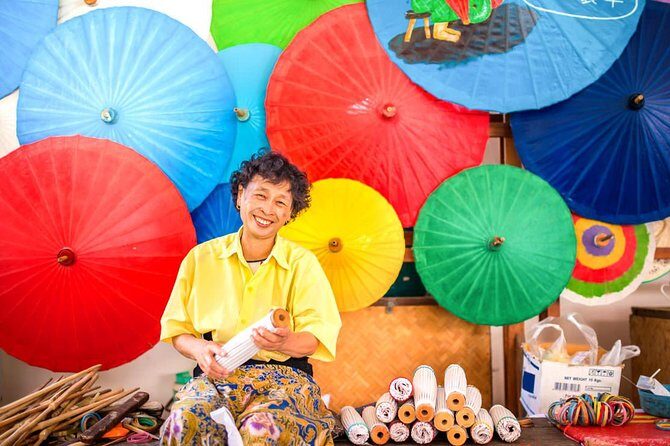
You start with pickup from your hotel and a short ride to the Sankampaeng district, a craft-focused area known for workshop activity. The first transfer segment is about 30 minutes, and the admission ticket here is listed as free.
This first move is about getting your bearings. Even before you reach the busiest part of the craft road, you’ll start noticing the kind of businesses concentrated along the route—factories, showrooms, and workshop spaces where people actually make things rather than just resell them.
If you’re the type who likes to plan your photos, this is also the time to do it. Once you get into the market streets and village lanes later, it’s harder to pivot your schedule. Use this segment to decide what you care about most: silk, wood carving, or umbrella craft.
The San Kamphaeng Saturday walking street market: silk weaving you can watch up close
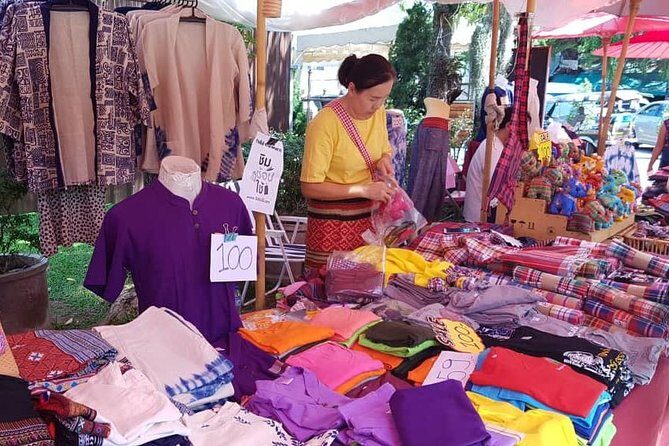
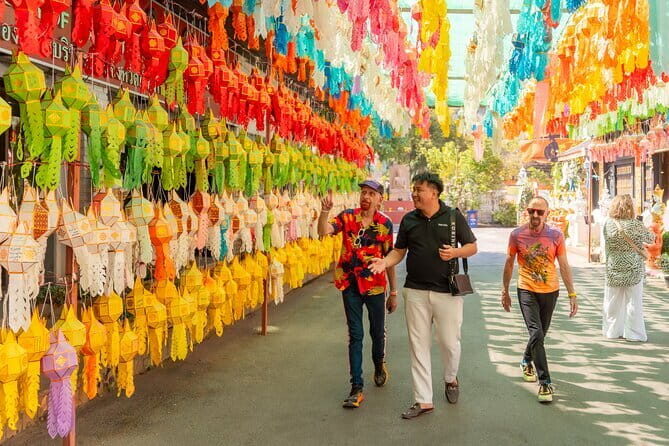
One of the best parts of this tour is the stop at the San Kamphaeng Saturday walking street market. This is described as the center of Thailand’s handicraft productions, so you’re not wandering randomly—you’re stepping into a place designed for craft activity and demonstrations.
You’ll spend about 1 hour here, and the admission is free. The main draw is the chance to watch locals demonstrate hand weaving of silk. The guide also explains the comprehensive, detail-oriented process of silk production.
What makes this practical (and not just “look at pretty textiles”) is that you get the sequence in your head: raw material to finished fabric. Even if you don’t remember every step, you’ll leave understanding why silk work costs what it costs. You’ll also get a better sense of what to look for if you’re tempted to buy later.
One small consideration: market stops can be crowded and you’ll likely be standing. If you don’t love close-up weaving stations, try to position yourself where you can see the work without blocking others.





Baan Jang Nak: elephant wood carvings plus a makers’ workshop feel
Next comes Baan Jang Nak – A Museum of Elephant Wood Carvings. This stop is built around the idea that carving isn’t magic—it’s process. You’ll venture through a well-known wood and furniture factory and learn how items move from raw material to finished pieces.
You’ll also spend about 1 hour here, with admission listed as free. The museum angle and the factory angle work together. The museum-style display helps you understand what you’re looking at, while the workshop/factory visit gives you context for how those pieces come to life.
There’s also an exhibit of locally made items like native costumes, jewelry, and home novelties. This part is useful if you want Thai craft culture beyond woodworking alone. You’ll see the same attention to detail applied across categories, not just one craft line.
In one review note I picked up from the experience description, a guide named Ms Ooh Lala was singled out for explaining multiple craft enterprises, including celadon work (thrown, glazed, and painted). That matches the spirit of this stop: you’re meant to connect different Thai craft traditions and see how they share the same patience and precision.
Bo Sang Umbrella Village: Saa-paper parasols made from scratch
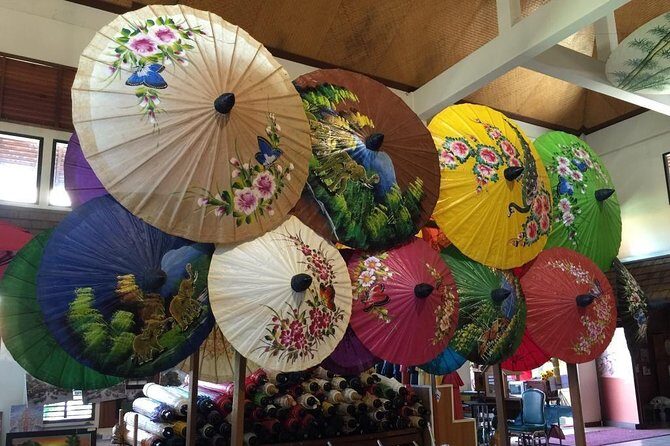
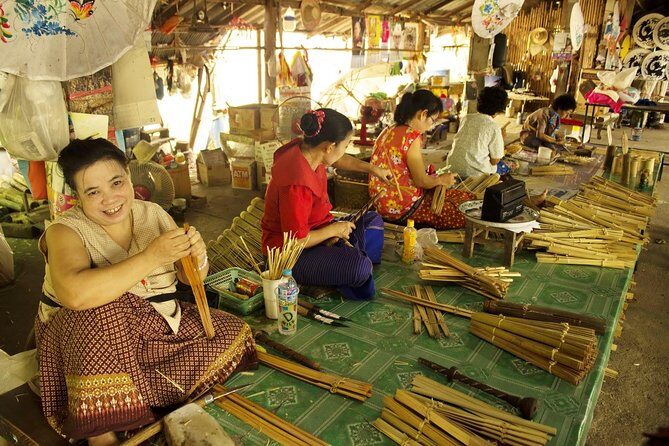
The final craft heavy-hitter is Umbrella Village (Bo Sang), famous for its Saa-paper parasols. You’ll learn how the umbrellas are made from scratch, and you’ll likely be able to watch the steps as they’re explained.
This stop is also about 1 hour, and admission is listed as free. The umbrella process is so visual that it’s easier to grasp than many quieter crafts. You can see the transformation from paper materials to the final parasol shape.
After that guided segment, you’ll have time to wander around the district, interact with locals, and browse for mementos before heading back. This is the part of the tour where you can turn interest into purchase if you want to. The tour format gives you permission to look first, then decide.
One practical thought: because this is a village area with streets and activity, it helps to keep your walking shoes on and your schedule loose enough to handle a few photo stops.
How good is this at $65: a value check for your morning
For a half-day experience, $65 isn’t the lowest price in Chiang Mai. But it can be fair value if you take a closer look at what you’re paying for.
You get:
- Guided visits to multiple craft production areas in a single route
- Hotel pickup and drop-off (for selected hotels, with clear free radius rules)
- Air-conditioned transport between stops
- Free admissions listed for each stop segment
- A small group size that helps you actually see and ask questions
If you were doing this DIY, you’d spend money on transport plus time figuring out how to arrange the stops efficiently. You might also miss the explanations that make crafts make sense. In a short tour window, paying for guidance is often what turns “I saw things” into “I understood what I saw.”
The only time it’s not such good value is if you mainly want to shop. If that’s your goal, you could spend your time in retail-heavy areas on your own. But if you want the making and the reasoning behind the craft choices, this price lines up with what you’ll get in four hours.
Who should book this tour (and who might skip it)
I’d recommend this tour if you:
- Like hands-on craft explanations (silk weaving, wood carving, umbrella making)
- Want a short itinerary that still feels culturally specific
- Prefer a small group and a guide who can answer questions
- Need an easy plan that fits around temples and night markets
You might skip it if you:
- Only want shopping time and don’t care about process
- Want a super slow pace or a deep, multi-hour workshop session
- Are uncomfortable standing and walking through markets and village streets
This is a good “craft culture” sampler. It’s not a full-day immersion in one craft.
Tips to make the silk and umbrellas feel meaningful
- Wear comfortable walking shoes. You’ll move through market and village areas.
- Bring a simple mental checklist: silk weaving, elephant wood carving process, Saa-paper umbrellas. It keeps the tour organized in your head.
- If you’re shopping for crafts, use the guided stops to learn what you’re actually looking at. The explanation helps you judge quality better.
- Go in knowing you’ll likely want a few photos, but aim to watch the step-by-step work too, not just the final product.
Should you book? My practical verdict
Book it if you want a straightforward half-day that connects Chiang Mai’s craft hubs: San Kamphaeng for weaving and workshop culture, Baan Jang Nak for elephant wood carving processes, and Bo Sang for umbrella making you can see from the start. It’s structured, small-group friendly, and built around learning rather than constant sales pressure.
Skip or postpone if you’re mainly after long shopping time or you hate short schedules. With only four hours, you’ll have to choose what you care about most and let the guide bring order to the craft chaos. For most people, that’s exactly why this tour is worth your morning.
FAQ
How long is the Half Day Traditional Handicraft Craftsmanship Tour?
It runs for about 4 hours.
What time does the tour start in Chiang Mai?
The start time is 8:00 am.
Is hotel pickup included?
Hotel pickup and drop-off are included for selected hotels. There is a 300 THB surcharge for pick up and drop off in hotels outside the city centre area (beyond the stated city centre distance).
Where does the tour go during the half day?
The main stops include San Kamphaeng district and a walking street market, Baan Jang Nak (elephant wood carvings), and Umbrella Village in Bo Sang.
Are admission tickets included?
Admission is listed as free for the stops.
What is the group size limit?
The tour has a maximum group size of 10 travelers.
Do I need a child ticket or accompaniment?
Children must be accompanied by an adult.